



Endometrial Preparation for Frozen Embryo Transfer: A Systematic Review
Article Summary
Frozen embryo transfer (FET) has become an increasingly important component of assisted reproductive treatment. Advances in embryo vitrification and the growing use of “freeze-all” strategies have led to a substantial increase in FET cycles worldwide. Despite this rapid growth, the optimal method for preparing the endometrium before frozen embryo transfer remains a matter of debate.
This systematic review evaluates the major endometrial preparation protocols used for FET and examines their potential effects on reproductive outcomes, including clinical pregnancy and live birth, as well as maternal, obstetric and neonatal outcomes. The authors reviewed evidence from PubMed and EMBASE, giving priority to randomized controlled trials, meta-analyses and large prospective cohort studies.
Major Endometrial Preparation Protocols
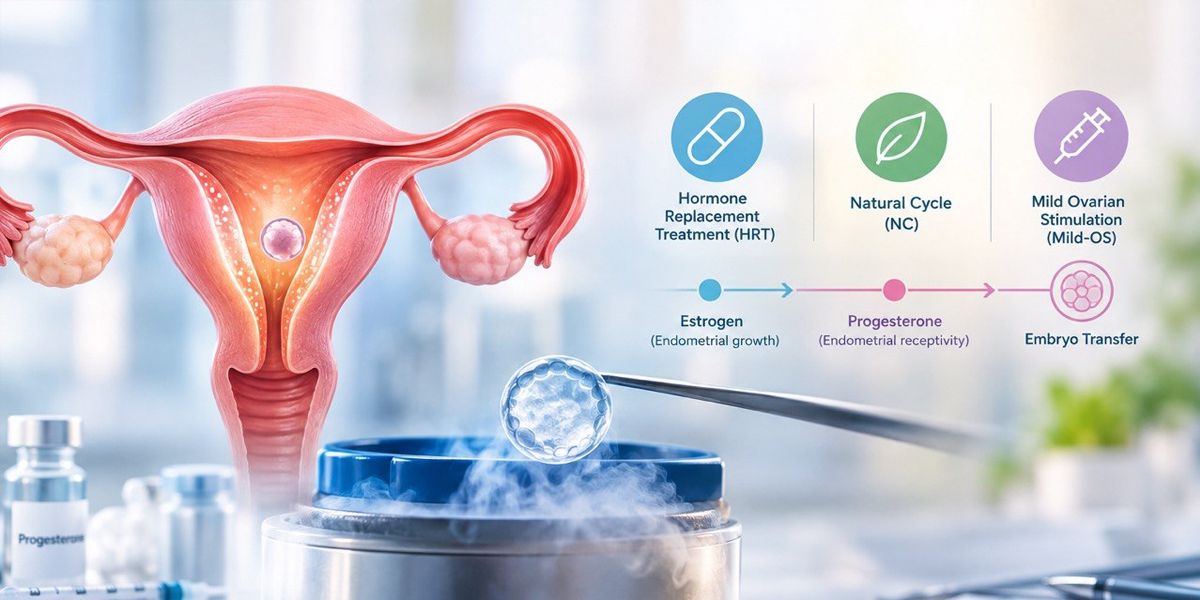
Three major approaches are discussed:
- Natural Cycle (NC)
- Hormone Replacement Treatment (HRT)
- Mild Ovarian Stimulation (Mild-OS)
Natural-cycle FET can be performed as either a true natural cycle or a modified natural cycle. In a natural cycle, endogenous estrogen and progesterone produced by the ovaries prepare the endometrium. In an HRT cycle, estrogen and progesterone are provided pharmacologically.
Hormone Replacement Treatment
In HRT-FET, estrogen is generally started early in the menstrual cycle to stimulate endometrial development. Once the endometrium reaches an appropriate stage, progesterone is initiated and the embryo-transfer date is scheduled according to the duration of progesterone exposure.
Estrogen can be administered orally or transdermally, and in selected circumstances vaginal administration may also be used. Available evidence does not demonstrate a clear difference in reproductive outcomes between oral and transdermal estrogen. The review also indicates that estrogen exposure can be relatively flexible, with approximately 10–36 days of preparation allowing greater flexibility in scheduling embryo transfer.
Progesterone is particularly important in HRT cycles because there is no corpus luteum. Therefore, all progesterone required to support the endometrium comes from exogenous supplementation. Vaginal and intramuscular progesterone are both widely used, but the available evidence does not establish a universally superior route.
Natural and Modified Natural Cycles
True natural-cycle FET requires accurate identification of spontaneous ovulation. This usually involves ultrasound monitoring and, when appropriate, assessment of LH and progesterone levels.
In a modified natural cycle, ovulation is triggered with hCG once the dominant follicle reaches an appropriate size. This approach generally requires less intensive monitoring and may therefore be more convenient for patients.
The evidence reviewed in the article does not demonstrate a consistent difference in live birth rates between true natural and modified natural cycles. Therefore, protocol selection may depend on menstrual regularity, monitoring requirements, patient characteristics and clinical practice.
For warmed blastocyst transfer, timing is particularly important. Based on the evidence available at the time of publication, transfer was generally scheduled around LH surge +6 days in a true natural cycle and hCG +7 days in a modified natural cycle. However, individual differences in the window of implantation and differences between day-5 and day-6 blastocysts may justify further adjustment of transfer timing.
Progesterone and Individualized Monitoring
One of the major findings of this systematic review is the importance of both the timing and concentration of progesterone exposure.
Studies indicate considerable individual variation in serum progesterone levels, even among patients receiving the same dose and route of administration. These differences may have an important relationship with reproductive outcomes.
This finding supports the concept of an individualized FET approach. Although direct measurement of progesterone within the endometrium is not practical in routine clinical care, serum progesterone can serve as a useful surrogate marker.
Several studies have also investigated progesterone “rescue” strategies for patients with low progesterone levels shortly before embryo transfer. Early findings suggest that supplementation may help correct low levels in some patients, but the authors emphasize that stronger randomized trials are required before definitive recommendations can be made.
Endometrial Thickness
Endometrial thickness is one of the most commonly assessed markers of endometrial readiness before embryo transfer. A thickness below approximately 7 mm is frequently considered a thin endometrium.
Available evidence suggests that endometrial thickness below 7 mm may be associated with lower clinical pregnancy and live-birth rates. However, endometrial thickness alone is not a sufficiently reliable predictor of treatment success. Extremely thin endometrium, particularly below 5 mm, has been associated with particularly poor outcomes.
Several treatments have been proposed for thin endometrium, including modifications in estrogen administration and a variety of adjunctive therapies. However, at the time of this review, no specific treatment had been conclusively demonstrated to improve reproductive outcomes in this population.
Natural Cycle Versus Hormone Replacement Treatment
One of the central conclusions of the review is that the available evidence, although generally of low quality, tends to favor natural-cycle approaches over HRT.
Randomized trials have not consistently demonstrated a significant difference in live birth rates between natural and HRT protocols. Nevertheless, more recent analyses and observational studies have reported outcomes that favor true or modified natural cycles. Based on the totality of the evidence, the authors concluded that natural-cycle approaches may have advantages over HRT, while emphasizing that the quality of evidence remains limited and that no single protocol can be considered optimal for every patient.
Mild ovarian stimulation, particularly with letrozole or low-dose gonadotropins, is also presented as a potentially useful alternative. Some studies have reported higher clinical pregnancy rates compared with HRT, but further research is required before firm conclusions can be drawn.
Pregnancy and Obstetric Outcomes
The review also highlights an important biological difference between natural and HRT cycles: the presence or absence of a corpus luteum.
In natural cycles, the corpus luteum produces hormones that contribute to the hormonal environment of early pregnancy. In contrast, an HRT cycle does not contain a corpus luteum, and hormonal support is provided entirely through medication.
Some studies reviewed in the article have raised concerns about an increased risk of hypertensive disorders of pregnancy in cycles without a corpus luteum. The authors consider this an important area for further research and emphasize that future trials should evaluate not only live birth, but also maternal, obstetric and neonatal outcomes.
Toward Personalized Frozen Embryo Transfer
A major theme of the review is the transition from a “one-size-fits-all” strategy toward individualized FET protocols.
Endometrial preparation and embryo transfer may be influenced by multiple patient-specific factors, including ovulation timing, progesterone concentration, route and dose of progesterone, age, body mass index and other biological characteristics.
The review also discusses tests such as the Endometrial Receptivity Array (ERA), which aim to identify an individualized implantation window. However, evidence regarding the clinical value of ERA remained conflicting at the time of publication, and the available data did not support routine use for all FET patients.
Conclusion
This systematic review indicates that there is still no universally accepted “best” protocol for endometrial preparation before frozen embryo transfer.
The available evidence, although limited in quality, generally points toward true or modified natural-cycle FET as a potentially favorable approach compared with HRT. Nevertheless, HRT remains an established and widely used protocol, while mild ovarian stimulation may be an appropriate alternative for selected patients.
Correct timing of embryo transfer is critical, particularly for blastocyst transfer, and should take into account progesterone exposure, the LH surge or hCG trigger, and embryo characteristics. The considerable individual variation in serum progesterone levels also supports a more personalized approach to luteal-phase management.
Ultimately, the authors call for large, well-designed randomized controlled trials that assess not only live birth rates but also maternal, obstetric and neonatal outcomes. The broader message of the review is that the future of frozen embryo transfer is likely to move toward individualized endometrial preparation, precise synchronization between embryo and endometrium, and hormone monitoring tailored to each patient.
Reference:
Mumusoglu S, Polat M, Yarali Ozbek I, et al. Preparation of the Endometrium for Frozen Embryo Transfer: A Systematic Review. Frontiers in Endocrinology. 2021;12:688237. doi:10.3389/fendo.2021.688237.