



In Vitro Fertilization and Intracytoplasmic Sperm Injection predictive factors: A review of the effect of female age, ovarian reserve, male age, and male factor on IVF/ICSI treatment outcomes
Abstract
The development of assisted reproductive technology has allowed offspring in infertile couples, and specifically, allowed infertile men to conceive through Intracytoplasmic Sperm Injection (ICSI). Despite the proven efficacy of In Vitro Fertilization (IVF) and ICSI, many factors can influence its success. In this review we present an analysis on the effect of Female age, Ovarian Reserve, Male age and Male factor on the outcomes of IVF/ICSI, to determine if and which can be applied to the practical context. A literature search on PubMed, EMBASE and MEDLINE for relevant articles was elaborated until July 2021, leading to the selection of 234 articles based on their titles. After reading through the abstracts, those that evaluated IVF/ICSI predicting factors were selected. Finally, only those approaching female age, ovarian reserve, male age and male factor were considered in this review. Higher female age and baseline ovarian markers alterations such as lower anti-Müllerian hormone and antral follicular count, and higher basal follicle-stimulating hormone, were associated with poorer outcomes. The predictive value of Male age and Male factor presented varied results across literature. The multifactorial nature of male fertility makes evaluation difficult. Although the first assessment of male infertility is based on sperm concentration, motility and morphology, semen parameters have shown low prognostic value, whilst sperm DNA alterations gain importance. Nevertheless, results remain controversial. While some factors have proven to predict IVF/ICSI success, other need to be further studied to be applied to practical context to allow the best prognosis possible.
Keywords: ART treatment outcomes; female infertility; in vitro fertilization; intracytoplasmic sperm injection; male infertility; ovarian reserve.
Since the beginning of this century, a decline in the number of children and a temporal delay in childbearing have been verified in developed countries. Among other causes, the growth in contraception, female emancipation, increase in economic wealth, personal education, life expectancy, and social normalization of divorce and mixed families, have contributed to delayed parenthood.[1] Both fecundity and fertility decrease with increasing age[2], causally turning couples to assisted reproductive technology (ART) to conceive.
A literature search on PubMed, EMBASE and MEDLINE for relevant articles was elaborated until July 2021. Combinations of the following terms were used as keywords: “ICSI”, “IVF”, “IVF/ICSI” and “predicting factor”, leading to the selection of 234 articles based on their titles. After reading through the abstracts, 182 articles were selected. Articles were considered relevant if they provided a clear investigation on the effect of intrinsic and extrinsic variables on ICSI outcomes, and then read entirely. Finally, those evaluating the effect of female age, male age, male factor, and ovarian reserve on IVF/ ICSI results were considered in this review, totalizing 96 papers.
Results:
Female age
Due to the surge in the use of ART, a parallel increase in the investigation of the effects of female age is seen. A common approach that was found in original articles studying the repercussion of female age on IVF/ICSI outcomes was the stratification of the cohort by age. The methods and design model of each study vary and whilst some study female age alone, others associate female age to other possible predicting factors.
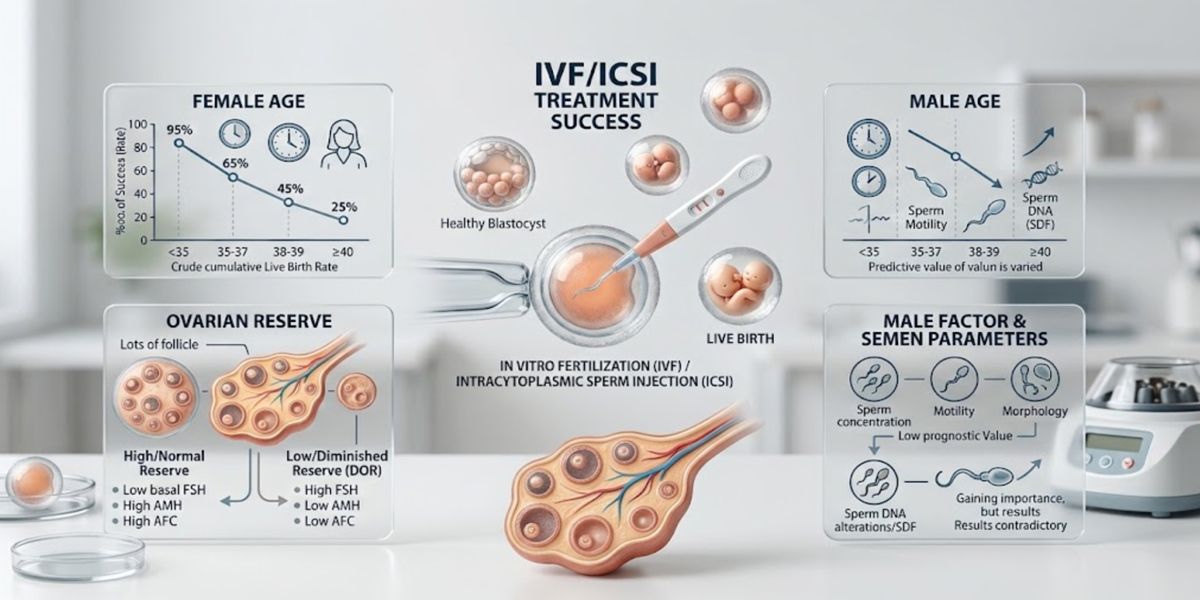
Within those whose object of evaluation was female age only, a negative relationship between IVF/ICSI outcomes and rising female age was predominant.[3]When evaluating the success of any ART technique, the LBR is the ultimate and most desired outcome. Cumulative LBR has been compared by dividing women in groups according to age.[4] Crude cumulative LBR (number of women achieving live-birth divided by the number of women who started treatment with ICSI) after one and six cycles, was found to decrease from 20-29, 30-37 to 38-39 years.[5] The decline in cumulative LBR was also found when dividing women in under 35 years, 35-37, 38-39, and ≥40 years[6]. In this case, the cumulative LBR among women 39 years of age or younger who were treated up to six cycles seemed to be similar to or higher than the cumulative LBR in the general population, suggesting that IVF was successful in the treatment of infertility but also implying that women aged 40 or over may find increased difficulty in reversing age-dependent decrease in fertility.[7]
Ovarian reserve
The decline of fertility with advanced female age is acknowledged. However, the etiology is still uncertain, with the decline in oocyte quantity and quality being a potential cause for poorer pregnancy outcomes [8]. The quantity and quality of residual ovarian follicles and oocytes is referred to as the ovarian reserve [9] and is a potential predictor of IVF/ICSI outcomes. Thus, the existence of ovarian reserve markers gains primary value. Currently, a variety of biochemical and sonographic tests allow this evaluation [10]. Serum levels of FSH and anti-Müllerian hormone (AMH), and the antral follicle count (AFC), are considered baseline factors predicting the ovarian reserve [11]. The third criterion of the Bologna ESHRE consensus group defines diminished ovarian reserve (DOR) as women presenting either an AFC ≤ 5-7 or an AMH assay ≤ 0.5-1 ng/mL [12]. Ovarian volume and blood flow, ovarian stimulatory test, gonadotropin agonist stimulation test [13], menstrual cycle lengths, levels of basal gonadotropins [14], estradiol and inhibin B concentrations can also assess the ovarian reserve [15].
It is important to distinguish DOR from poor ovarian responders (POR). POR are defined by the ESHRE Bologna consensus when at least two of the three characteristics are present: advanced maternal age (≥ 40 years) or any other risk factors for POR (all the known genetic or acquired conditions possibly linked to a reduced amount of resting follicle), a previous poor ovarian response (≤ 3 oocytes with a conventional stimulation protocol) or an abnormal ovarian reserve test (AFC <5-7 or AMH < 0.5-1.1 ng/mL) [16].
Male age
When analysing previous studies, it turns out that the influence of male age on clinical outcomes is contradictory, varying in the results obtained and the ages considered.
Most studies found no association between male age and FR
However, some studies found that paternal age was an independent factor negatively affecting the FR
Male age and sperm parameters
The influence of male age on sperm parameters is more established and better understood. Male aging can directly damage sperm DNA and increase DNA methylation through excessive reactive oxygen species production, and then compromise spermatogenesis [17]. revealed a significant relationship between paternal age and all sperm parameters. They described that for every 5 years of age, sperm volume decreased by 0.22 ml, concentration increased by 3.1 million sperm/ml and the percentage of motile spermatozoa decreased by 1.2%. [18]
reported no significant association between male age groups and sperm concentration, morphology and DNA fragmentation index (DFI) but identified a significant decrease in sperm motility. Specifically, males between 40-49 years had a 52% reduced chance to have normal sperm motility (≥32% progressively motile sperm), whilst males ≥50 years of age had a 79% reduced chance for normal motility [19]. A close correlation between the patients age and the percentage of vacuoles in the motile sperm organelle morphology examination (MSOME), sperm aneuploidies and DNA fragmentation has been reported. [20] Nevertheless, results remain contradictory. Some authors described no relationship between paternal age and any sperm parameter, such as concentration, motility or morphology, and no increase in DFI or immature chromatin.[21]
CONCLUSION
The increasing phenomenon of delayed parenthood, associated to the inherent effects of aging on reproductive capacity, has led to an increase in the search of ART to conceive. Thus, the investigation on the possibility of factors, existing before initiating a stimulation protocol, that could influence IVF and ICSI outcomes, has grown in literature, reporting various but also contradictory results. In an effort to analyse these findings and establish a consensus in literature, we reviewed the effect of female age, male age, ovarian reserve and male factor on IVF/ICSI success.
Most studies report no association between male age and CP, IR and LBR, but others contradict these results. The contrast in results can be explained by several hypotheses: only a few normal spermatozoa are required for successful ICSI; ICSI can surpass possible sperm alterations due to advanced male age; the male age cohorts used in different studies vary; and due to the bias introduced by female age. Male age reveals a significant relationship with all sperm parameters and can directly damage sperm DNA and compromise spermatogenesis, but no association to oocyte, blastocyst and embryo parameters were found.
[1] De Brucker et al., 2014; Meijerink et al., 2016; O’Brien et al., 2017; Carrasquillo et al., 2019.
[2] O’Brien et al., 2017
[3] Malizia et al., 2009; Cetinkaya et al., 2013; De Brucker et al., 2014; Tan et al., 2014; Yilmaz et al., 2017; Mahesan et al., 2018.
[4] Malizia et al., 2009; De Brucker et al., 2014.
[8] La Marca et al., 2017.
[9] Yin et al., 2019.
[10]Nelson et al., 2007; Lee et al., 2009.
[11]Nelson et al., 2007; Lee et al., 2009; Fridén et al., 2011; Brugo Olmedo et al., 2013; Li et al., 2016; Yin et al., 2019.
[12] Ferraretti et al., 2011.
[13] Lee et al., 2011.
[14] Brodin et al., 2013.
[15] Lee et al., 2011; Li et al., 2016.
[16] Ferraretti et al., 2011.