



Predictors of Success After In Vitro Fertilization (IVF)
Introduction
In vitro fertilization (IVF) is one of the major treatment options for infertility and has advanced considerably over recent decades. Nevertheless, treatment outcomes vary among individuals and couples and are influenced by a combination of demographic, clinical, and laboratory factors. Identifying these predictors can help clinicians estimate the probability of live birth more accurately and provide patients with realistic information when making treatment decisions.
The 2024 review by Shingshetty and colleagues, published in Fertility and Sterility, examined the factors commonly used to predict IVF success and their associations with live birth outcomes.
Methods
The authors reviewed studies published between 1978 and November 2023. A total of 43 publications involving the development of IVF outcome prediction models were included. These models used statistical methods, including logistic regression, as well as machine-learning algorithms to examine associations between patient characteristics, treatment variables, and IVF outcomes.
Main Findings
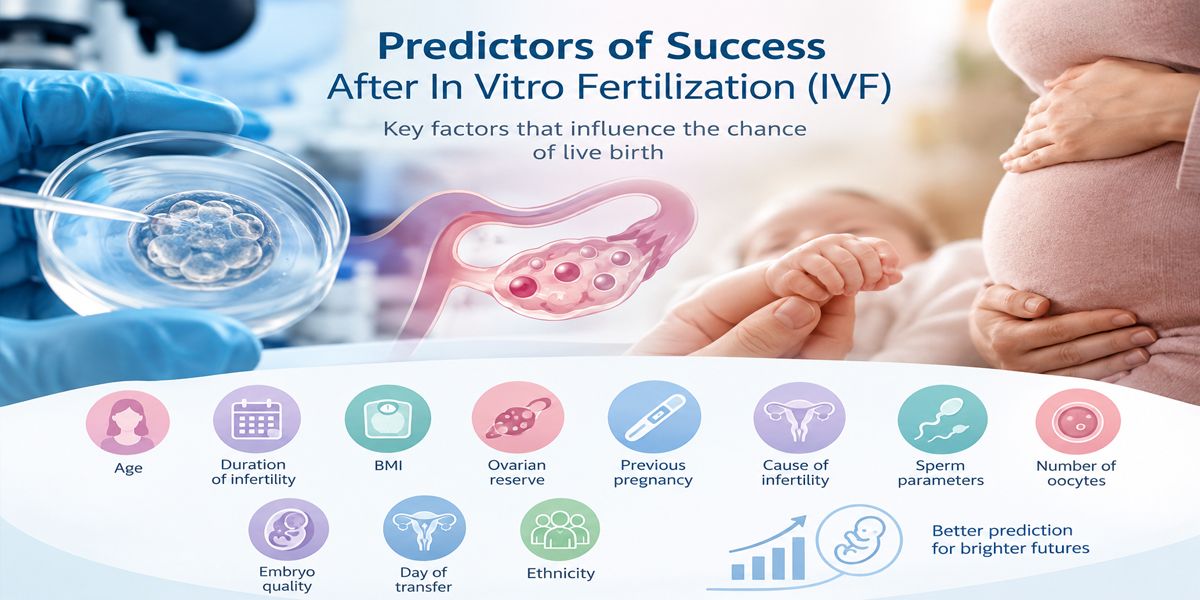
The review identified 11 predictors that frequently appeared in IVF success prediction models.
- Female age
Female age is one of the most important predictors of IVF success. Increasing age, particularly beyond 35 years, is generally associated with declining ovarian reserve and reductions in oocyte quantity and quality. These changes may affect fertilization, embryo development, and the probability of live birth.
- Duration of infertility
The duration of infertility is another important variable in prediction models. A longer history of infertility may be associated with a lower probability of treatment success, although this relationship also depends on age, the underlying cause of infertility, and other clinical characteristics.
- Body mass index (BMI)
Body weight may be associated with reproductive function and treatment outcomes. Some studies have reported more favorable outcomes among individuals with a BMI within the normal range. However, BMI alone is insufficient to predict IVF success and should be interpreted alongside other clinical factors.
- Ovarian reserve
Antral follicle count (AFC) and anti-Müllerian hormone (AMH) are commonly used to assess ovarian reserve. These measures help predict ovarian response to stimulation, but their ability to predict live birth directly is limited. Their results should therefore be considered alongside female age and other clinical information.
- Previous pregnancy history
Previous pregnancy history can contribute to the assessment of success in subsequent treatment cycles. In particular, a previous live birth following IVF may be associated with a higher probability of success in later cycles. However, previous pregnancy does not guarantee a favorable outcome in future treatment.
- Cause of infertility
The underlying cause of infertility, including ovulatory disorders, tubal disease, endometriosis, and male-factor infertility, may influence treatment outcomes. The importance of each factor depends on the individual clinical context and the treatment approach.
- Sperm parameters
Sperm concentration and motility are relevant to the assessment of male fertility and may help predict certain treatment outcomes. However, the contribution of individual semen parameters to live birth varies across studies and should be interpreted in the context of the couple’s overall clinical profile.
- Number of oocytes retrieved
The number of oocytes retrieved following ovarian stimulation can influence the number of embryos available for treatment and the cumulative probability of live birth. However, a greater number of oocytes does not necessarily translate into a proportionate increase in success per treatment cycle. Ovarian stimulation must also be managed with consideration of patient-specific risks and potential complications.
- Embryo quality
Embryo morphology and developmental stage are important considerations when selecting embryos for transfer. These characteristics can contribute to estimates of implantation and live birth probability, although favorable embryo morphology alone does not guarantee a successful pregnancy.
- Day of embryo transfer
Embryo transfer may occur at the cleavage stage or at the blastocyst stage. The choice of transfer timing depends on the patient’s circumstances, the number and quality of available embryos, and the treatment strategy. The reviewed evidence does not establish that one transfer stage is universally superior for all patients.
- Ethnicity
Some studies have reported differences in IVF outcomes across ethnic groups. These findings should be interpreted cautiously because socioeconomic circumstances, access to fertility care, and clinical characteristics may also contribute to the observed differences.
The Role of Artificial Intelligence in Predicting IVF Success
Machine-learning models can analyze multiple clinical and laboratory variables simultaneously to generate individualized estimates of treatment success. These approaches may help identify complex relationships among predictors and could improve pre-treatment counseling in the future.
However, clinical implementation requires careful evaluation of model accuracy, generalizability, and validation in different populations. Furthermore, a model’s ability to predict an outcome does not necessarily establish a causal relationship between its predictors and treatment success.
Study Limitations
This review focused on predictors used in IVF outcome prediction models rather than providing a comprehensive evaluation of the clinical performance of every available model. Differences in variable definitions, measurement methods, reporting practices, and statistical approaches also limited direct comparisons of the relative importance of individual predictors. Further research is therefore needed to establish the predictive value of specific variables and support broader clinical implementation.
Conclusion
IVF success is influenced by a combination of demographic, clinical, and laboratory factors. Female age is among the most important predictors of treatment outcome; however, no single clinical variable or laboratory test can determine with certainty whether IVF will succeed or fail.
Individualized prediction models, particularly those incorporating advanced statistical methods and machine learning, may improve patient counseling, support realistic expectations, and facilitate more informed treatment decisions. Ultimately, estimates of IVF success should be based on a comprehensive assessment of each couple’s circumstances and an understanding of the limitations of prediction models.
Reference:
Shingshetty L, Cameron NJ, McLernon DJ, Bhattacharya S. Predictors of success after in vitro fertilization. Fertility and Sterility. 2024;121:742–751.